
BRANDING
The Role of Naming in Communication & Music
History of Communication Studies and the Classic Diagram
Communication scholars have long studied how messages transfer from sender to receiver. Early research focused on clarity, noise, interpretation, and misunderstanding. A recurring finding across this work is that communication failure often stems from assumed shared reference rather than from complex language or lack of intelligence.
One example frequently cited in textbooks comes from psycholinguistic research on instruction giving. In experiments such as Glucksberg’s stacked blocks task, one participant verbally instructs an unseen partner to recreate a physical configuration. Despite the task’s simplicity, results vary. Errors occur when speakers rely on internal mental models that listeners do not share (Clark & Brennan, 1991; Krauss & Fussell, 1996). Successful outcomes depend on shared context and precise descriptive language.
Similarly, in college courses on interpersonal communication, students often participate in a related instructional exercise (figure below). One person verbally describes a visual image without gestures, drawings, or clarification. The audience must recreate the image using language alone. A standard version uses four adjacent rectangles arranged in a grid, with a single bell-shaped curve spanning across them. When the drawings are compared at the end, the results differ substantially. Some resemble the original. Most miss key spatial relationships. Others reconstruct a different image altogether.
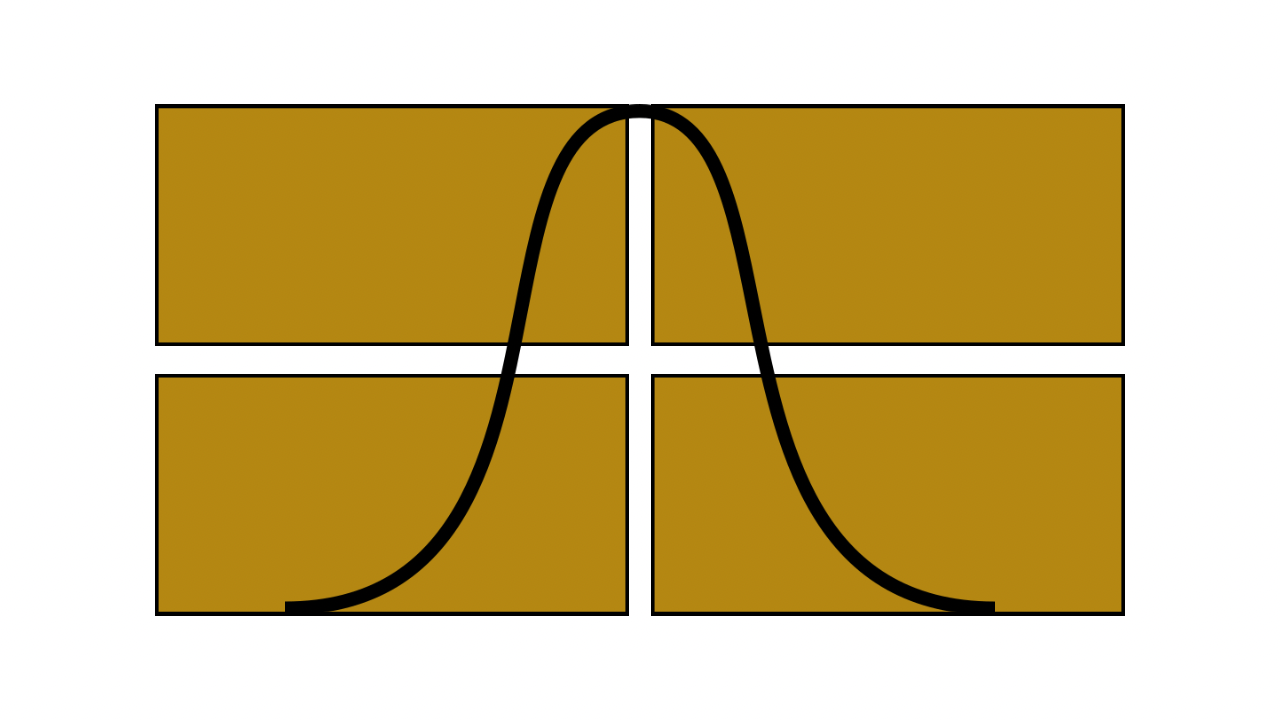
This classroom exercise belongs to referential communication research. Like the stacked blocks task, it demonstrates how ambiguity, assumed reference, and vague descriptors generate interpretive divergence even in controlled settings. The variation is systematic rather than random. The lesson is not artistic failure. The lesson is how meaning fragments when language lacks shared anchors.
These experiments illustrate a central principle of communication research. When instructions lack sufficient context or specificity, listeners compensate by inferring from assumptions, producing variation in outcomes rather than a uniform understanding (Kellner, 2022). Empirical research on language ambiguity confirms the pattern between speaker intent and listener interpretation. As specificity decreases, comprehension accuracy drops across subjects.
These findings extend beyond laboratory and classroom settings. In organizational communication, ambiguity in roles and language predicts misunderstandings that affect outcomes, trust, and coordination. Researchers draw on sensemaking theory and role theory to explain why breakdowns occur (Weick, 1995; Jablin, 1987). When communicators lack shared definitions and guiding frameworks, interpretive gaps widen even in simple exchanges.
Taken together, this body of research establishes a baseline principle. Communication effectiveness depends on clarity, shared reference points, and structured meaning. When those elements weaken, listeners do not receive less meaning. They generate their own.
The Importance of Names
Naming is a central element in communication, branding, and perception. Naming research in brand management describes names as one of the most critical elements of brand identity, essential for memorability, differentiation, and market presence. Names are the first cognitive interface between a product and its audience, and poor naming often leads to confusion or weak brand equity (Eskiev, 2021).
Psychological research supports the idea that brand names occupy a unique cognitive status distinct from that of general nouns or personal names. They trigger associations, emotions, and memory responses that influence perception and preference. Because names are repeated across contexts, familiarity influences preference and recall (Zhang). Research on associative networks shows that names serve as anchor nodes linking complex meaning structures in consumers’ minds.
In music, band names function similarly. They are not mere labels. They are the primary identifiers audiences use to classify, remember, and emotionally respond. A name that evokes unintended associations can lead to confusion, rejection, or misinterpretation before anyone hears the music. This phenomenon aligns with the documented effect of vague or irrelevant names diluting brand meaning.
How to Choose a Band Name: Resources and Criteria
The naming process in branding offers explicit criteria for band names. Effective name generation often involves testing for memorability, meaningfulness, ease of pronunciation, and uniqueness. Keller and Lehmann highlight six criteria for strong brand elements, including memorability, meaningfulness, aesthetic appeal, and transferability across contexts. A name that fits these criteria functions better in global markets, across cultures, and over time.
Research on sound symbolism shows that the phonetic characteristics of a name influence listeners’ perception. Certain sounds evoke impressions of size, motion, or emotional tone. For example, hard consonants can signal strength and energy while softer sounds may convey comfort or harmony (Placek, 2023). This effect is consistent across languages and affects recall and preference.
Practical naming approaches include:
- Semantic relevance: Choose words that reflect genre, themes, or artistic identity.
- Phonetic appeal: Ensure the name sounds congruent with musical style.
- Distinctiveness: Avoid generic, overly common, or culturally conflicting terms.
- Testing for associations: Evaluate possible unintended interpretations across audiences and cultures.
Computational research also offers quantitative methods to score names (Hiranandani, G. et al., 2017). Pronounceability, readability, uniqueness, and memorability support systematic selection rather than relying on intuition.
Trendy vs. Non-Trendy Names
Band names vary from trendy, fashionable constructions to ones rooted in deeper thematic or genre connections. Trendy names often follow short-lived cultural patterns or memes. These names may catch attention in the short term, but risk rapid obsolescence if they fail to form strong semantic links to music identity.
Examples from documented etymology of musician names show trends and deeper reference points:
- Trend-driven: Many early punk and avant-garde names served shock or surprise value.
- Contextual meaning: Bands like Burning Spear reference cultural roots and ideological motifs.
- Subcultural reference: Names that refer to specific literary, historical, or symbolic contexts build stronger long-term identity.
Some names that were deliberately provocative or obscure had lasting relevance because they captured an artistic ethos rather than surface trend, e.g., Bad Religion or Buzzcocks. (Wikipedia). In contrast, names hinged on ephemeral trends often fade as styles shift.
Postmodern Art of Band Names and Timeless Identity
Band names also operate within larger cultural and artistic movements. Postmodern naming embraces intertextuality, irony, and hybrid references that merge classical and modern ideologies. Postmodern art theory suggests that art exists in layers of cultural context, parody, and fragmentary reference. In naming, this translates into names that are at once reflective and referential rather than literal.
A timeless name often:
- Bridges classical and contemporary themes.
- Evokes a recognizable image without rigid specificity.
- Suggests depth of meaning rather than surface trend.
Zhang goes on to describe how naming scholarship emphasizes that names aligned with deeper cultural and emotional patterns have stronger memory and identity effects across audiences and over time.
The Logical Fallacy of “This Music Is for Everyone”
Finally, claiming that any music is for everyone involves a logical error rooted in communication and social psychology. This claim implies a sweeping generalization that a diverse audience shares identical tastes or responses. Sweeping generalizations ignore variation in listeners’ interpretations, cognitive frameworks, and cultural backgrounds.
This type of error mirrors a well-studied cognitive bias, the false consensus effect, where individuals overestimate how much others share their beliefs or preferences. In communication, assuming uniform reception disregards audience diversity and context. Psychological research finds that individuals fill gaps in vague messages with personal assumptions, often inaccurately (Patterson, 2023).
Band names that attempt to position music as universally accessible without accounting for interpretive differences risk miscommunication (Kellner, 2022). Audiences handle ambiguity by applying personal frameworks, which often leads to unintended associations, reinforcing misalignment between the creator’s intention and the audience’s reception.
Conclusion
Communication research shows that clarity, context, and shared reference points are essential for successful information transfer. Ambiguous instructions and names lead to divergent interpretations. Naming in branding and music has measurable cognitive and emotional impacts. Effective names balance semantic relevance, phonetic appeal, cultural resonance, and memorability.
Trendy names may gain short-term traction, but deeper, concept-linked names produce more enduring identities. Claims that music is for everyone rely on unfounded generalizations. Understanding audience diversity and interpretive frameworks strengthens communication and artistic identity.
The integrated view emphasizes that naming is not superficial. Names shape listener expectations, memory, and cultural meaning. In music and beyond, careful naming grounded in research leads to a stronger connection and more transparent communication.
References
Clark, H. H., & Brennan, S. E. (1991). Grounding in Communication. In L. B. Resnick, J. M. Levine, & S. D. Teasley (Eds.), Perspectives on Socially Shared Cognition (pp. 127–149). American Psychological Association.
Eskiev, M. (2021). Naming as One of the Most Important Elements of Brand Management. SHS Web of Conferences.
Hiranandani, G., Maneriker, P., & Jhamtani, H. (2017). Generating Appealing Brand Names.
Jablin, F. M. (1987). Organizational Entry, Assimilation, and Disengagement. In F. M. Jablin et al. (Eds.), Handbook of Organizational Communication (pp. 679–740). Sage Publications.
Kellner, C. (2022). Reacting to Ambiguous Messages. Elsevier.
Krauss, R. M., & Fussell, S. R. (1996). Social Psychological Models of Interpersonal Communication. In E. T. Higgins & A. W. Kruglanski (Eds.), Social Psychology: Handbook of Basic Principles (pp. 655–701). Guilford Press.
Patterson, M. L. (2023). Four Misconceptions about Nonverbal Communication. PMC.
Placek, D. (2023). The Science of Sound Symbolism and the Importance of Your Brand Name.
Zhang. The Mental Representation of Brand Names.
Wikipedia. List of Musician and Band Name Etymologies.
Keller & Lehmann. (2025) Consumer/ Shopper/ Customer Behaviour: Putting the Brand Name in its Right Place.
Weick, K. E. (1995). Sensemaking in Organizations. Sage Publications.
The Role of Naming in Communication & Music


Leave a Reply
Want to join the discussion?Feel free to contribute!