
BUSINESS 101
Volunteer Ceiling & the Structural Crisis Facing Modern Arts Nonprofits
Across the United States, many arts and music nonprofits were originally built around a volunteer-era operational model. Leadership structures formed during periods when organizational demands were smaller, audiences were more localized, administrative requirements were lighter, and digital infrastructure did not exist on a modern scale.
Boards often consisted of community members donating spare time outside their careers. Event promotion relied on flyers, local word-of-mouth, and limited print outreach. Sponsorship expectations were lower. Compliance burdens were simpler. Insurance requirements were less aggressive. Audiences had fewer entertainment options competing for attention.
That operational environment no longer exists.
Modern nonprofit organizations now operate within a professionalized environment requiring continuous execution across multiple disciplines simultaneously:
- Event production
- Social media management
- Digital advertising
- Sponsorship development
- Accounting
- Legal compliance
- Insurance coordination
- Volunteer management
- Donor relations
- Email marketing
- Grant writing
- Public relations
- Venue negotiations
- Artist relations
- Ticketing systems
- Partnerships
- Branding
- Strategic planning
Many organizations continue to expect these responsibilities to be performed entirely through unpaid labor.
Growing operational demands combined with continued reliance on fully volunteer labor structures increasingly threaten the long-term sustainability of nonprofits.
The Volunteer Ceiling
Volunteer-led organizations have played an essential historical role in preserving local arts communities and cultural traditions.
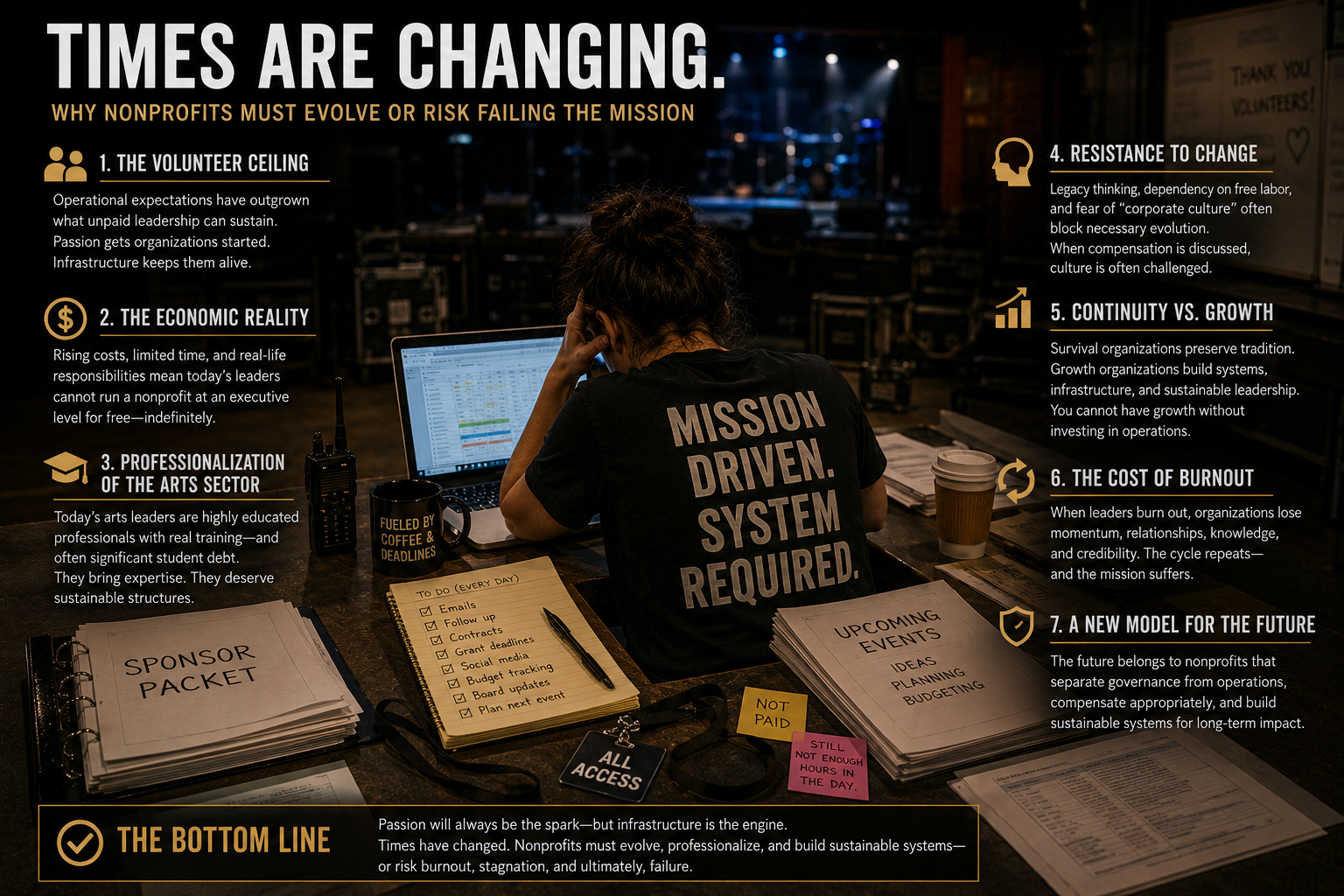
The “volunteer ceiling” occurs when operational expectations exceed what unpaid leadership can realistically sustain.
At first, passionate and highly capable individuals enter leadership positions because they believe deeply in the mission. Many possess professional-level skills in:
- Operations
- Marketing
- Production
- Finance
- Branding
- Communications
- Fundraising
- Strategic planning
These individuals frequently become the operational backbone of the organization.
Because they are competent, reliable, well-connected, and willing to work, more responsibility gradually accrues to them. Over time, volunteer leadership evolves into executive operational labor that resembles a part-time or full-time job.
The organization begins depending on:
- Unpaid overtime
- Personal financial sacrifice
- Unpaid transportation
- Unpaid equipment usage
- Unpaid communication labor
- Unpaid administrative labor
- Emotional labor
- Personal relationships and networks
- After-hours execution
Meanwhile, leadership still receives no sustainable compensation structure.
Eventually, burnout develops.
Leaders carrying significant operational responsibility often recognize that the workload increasingly resembles professional operational management, while the surrounding structure remains rooted in a legacy volunteer model.
At that stage, organizations often lose their highest-capacity workers.
The Economic & Professional Shift
Many legacy nonprofit cultures still operate from assumptions established decades ago.
Those assumptions include:
- Passionate people will always volunteer indefinitely
- Leadership should sacrifice financially for the mission
- Compensation weakens nonprofit integrity
- Operational labor should remain unpaid
- Organizational legitimacy comes from volunteerism alone
Modern economic realities directly challenge these assumptions.
Current leaders face:
- Rising housing costs
- Healthcare expenses
- Fuel costs
- Technology subscriptions
- Increased work hours within their own careers
- Family responsibilities
- Unstable economic conditions
Younger professionals and working-age adults often cannot sustain executive-level nonprofit labor without some form of:
- Salary
- Stipend
- Contractor agreement
- Operational reimbursement
- Project-based compensation
- Production fee structure
This does not reflect greed or lack of passion.
It reflects economic reality.
Mission-driven labor still requires sustainability.
Another major shift many organizations fail to recognize is that today’s arts administrators and nonprofit leaders are increasingly highly educated professionals with formal training in music business, arts administration, nonprofit management, finance, marketing, and organizational leadership.
Across Houston and throughout the country, many arts administrators and nonprofit leaders now enter the sector with formal education and professional training in music business, arts administration, nonprofit management, finance, marketing, and organizational leadership. Professionals with advanced degrees increasingly work within orchestras, performing arts organizations, nonprofits, and cultural institutions in operational, financial, and administrative roles. Modern arts organizations often depend on individuals with experience in budgeting, fundraising, communications, strategic planning, and event operations.
Many emerging leaders now enter the arts sector with advanced education and professional training in music business, arts administration, nonprofit management, finance, marketing, and organizational leadership. Universities and specialized arts programs across the country are producing professionals trained in:
- Budgeting
- Nonprofit finance
- Fundraising
- Marketing strategy
- Sponsorship development
- Organizational leadership
- Digital communications
- Event operations
- Contract administration
- Strategic planning
Unlike earlier decades, when many arts organizations operated more informally, modern nonprofit operations increasingly require professional-level expertise.
Modern nonprofit operations increasingly require significant time, coordination, and professional expertise, creating new challenges for organizations built entirely around volunteer leadership models.
This is especially true for organizations that expect professional branding, sophisticated marketing, financial accountability, sponsorship growth, digital engagement, strategic expansion, and operational consistency while continuing to rely primarily on volunteer labor structures developed during a very different operational era.
The issue is not a lack of passion: it’s that the arts sector has evolved into a highly skilled professional environment, while many organizational cultures still operate under assumptions formed during a very different economic and operational era.
Resistance to Operational Compensation
Resistance to compensated operational leadership often comes from cultural and emotional factors rather than legal limitations.
Common reactions include:
- “We never got paid before.”
- “Everyone should volunteer.”
- “Nonprofits should not pay leadership.”
- “If someone truly cares, they would do it for free.”
- “Paying staff feels corporate.”
These reactions frequently emerge from individuals whose understanding of nonprofits formed during earlier economic periods.
Some organizations also develop unconscious dependency on high-capacity volunteers. Once capable individuals consistently solve problems, execute events, secure partnerships, and maintain operations, boards begin viewing that labor as permanently available.
When compensation enters the conversation, discomfort emerges because the organization is suddenly forced to confront the true operational value of work previously performed for free.
In some cases, discussions around compensation trigger dismissive reactions, defensiveness, or ridicule because compensation challenges the organization’s cultural identity.
Unsustainable contradictions are created when problems become particularly severe, when organizations simultaneously:
- Expect professional execution
- Demand organizational growth
- Pursue larger events
- Seek expanded sponsorships
- Request higher visibility
while - Refusing operational infrastructure
The Difference Between Continuity & Growth
Many nonprofits unintentionally confuse continuity with growth.
- Continuity-focused organizations prioritize:
- Preserving tradition
- Maintaining social familiarity
- Keeping the organization alive
- Hosting limited recurring activities
- Operating at a survivable scale
2. Growth-focused organizations require:
- Infrastructure
- Measurable systems
- Operational accountability
- Delegated responsibilities
- Fundraising strategy
- Compensated execution
- Marketing consistency
- Production planning
- Partnership development
- Leadership sustainability
Neither model is inherently wrong.
Problems arise when organizations expect growth-level outcomes while maintaining continuity-level operational structures.
Examples include:
- Expecting large-scale productions without staffing
- Expecting marketing consistency without compensated communications support
- Expecting sponsorship growth without development infrastructure
- Expecting executive-level accountability from unpaid volunteers
- Expecting year-round operational availability from individuals balancing full-time careers
This mismatch becomes one of the leading causes of nonprofit stagnation.
Costs of Volunteer Burnout
When operational leadership burns out, nonprofits lose more than individuals.
They lose:
- Institutional memory
- Sponsor relationships
- Community trust
- Operational systems
- Production knowledge
- Marketing continuity
- Fundraising momentum
- Strategic partnerships
- Audience growth patterns
- Leadership stability
Many nonprofits enter recurring cycles where:
- Passionate leaders enter
- Operational workload expands
- Burnout develops
- Leaders resign abruptly
- Organizational momentum collapses
- Recruitment becomes harder
- Fewer capable leaders volunteer
- Programming quality declines
Eventually, the organization survives only through minimal continuity operations rather than meaningful growth.
Myth: Compensation Threatens Nonprofit Status
Federal nonprofit law does not prohibit operational compensation.
The IRS permits reasonable compensation for legitimate labor when:
- Duties are real
- Compensation is documented
- Conflicts of interest are managed
- Approval processes are transparent
Many successful nonprofits operate with:
- Paid Executive Directors
- Contracted event coordinators
- Compensated development staff
- Marketing contractors
- Operations managers
- Stipend-supported leadership
Long-term mission stability depends on sustainable operational infrastructure. Without consistent leadership systems, organizational support, and operational capacity, even strong missions can become difficult to maintain over time.
Emerging Hybrid Model
As nonprofit environments become more demanding, many organizations are transitioning toward hybrid structures combining:
- Volunteer governance
- Compensated operations
- Contractor-based execution
- Stipend-supported leadership
- Project-specific staffing
Examples include:
- Board members remaining volunteer-based
- Event producers receiving per-event compensation
- Marketing is handled through contractors
- Operational coordinators receive monthly stipends
- Grant-funded executive support roles
This model preserves mission integrity while acknowledging the economic realities of modern organizational labor.
The Future of Arts Nonprofits
The arts sector increasingly depends on organizations capable of balancing mission-driven culture with sustainable operational systems.
Volunteerism still matters deeply. Community participation remains essential.
Yet organizations refusing to adapt structurally risk:
- Declining leadership pools
- Recurring burnout
- Operational instability
- Reduced programming quality
- Stagnating audiences
- Sponsorship decline
- Volunteer exhaustion
- Ongoing structural instability
- Organizational collapse
Modern nonprofit sustainability requires recognizing that passion alone cannot indefinitely replace infrastructure.
The organizations most likely to survive long term will be those willing to:
- Professionalize operations
- Separate governance from execution
- Create sustainable leadership systems
- Respect operational labor as legitimate work
- Align responsibility with support structures
- Build infrastructure alongside the mission
Times have changed.
Organizations adapting to those changes position themselves for resilience, growth, and long-term cultural impact.
Organizations refusing to adapt often remain trapped in recurring cycles of burnout, instability, and operational decline despite strong missions and passionate communities.
Luke 10:7
References
Americans for the Arts. (2018). Arts & Economic Prosperity 5: The Economic Impact of Nonprofit Arts and Cultural Organizations and Their Audiences. Americans for the Arts.
Drucker, P. F. (1990). Managing the Nonprofit Organization: Principles and Practices. HarperCollins.
Froelich, K. A. (1999). Diversification of Revenue Strategies: Evolving Resource Dependence in Nonprofit Organizations. Nonprofit and Voluntary Sector Quarterly, 28(3), 246–268.
Hansmann, H. (1980). The Role of Nonprofit Enterprise. Yale Law Journal, 89(5), 835–901.
Independent Sector. (2024). Value of Volunteer Time. https://independentsector.org
Kotler, P., & Scheff, J. (1997). Standing Room Only: Strategies for Marketing the Performing Arts. Harvard Business School Press.
National Center for Charitable Statistics. (2023). The Nonprofit Sector in Brief 2023. Urban Institute.
Oster, S. M. (1995). Strategic Management for Nonprofit Organizations: Theory and Cases. Oxford University Press.
Salamon, L. M. (2012). America’s Nonprofit Sector: A Primer (3rd ed.). Foundation Center.
U.S. Internal Revenue Service. (2024). Charities and Nonprofit Organizations. https://www.irs.gov/charities-and-nonprofits
Wolf, T. (2012). Managing a Nonprofit Organization in the Twenty-First Century (2nd ed.). Simon & Schuster.
Volunteer Ceiling & the Structural Crisis Facing Modern Arts Nonprofits

Leave a Reply
Want to join the discussion?Feel free to contribute!