
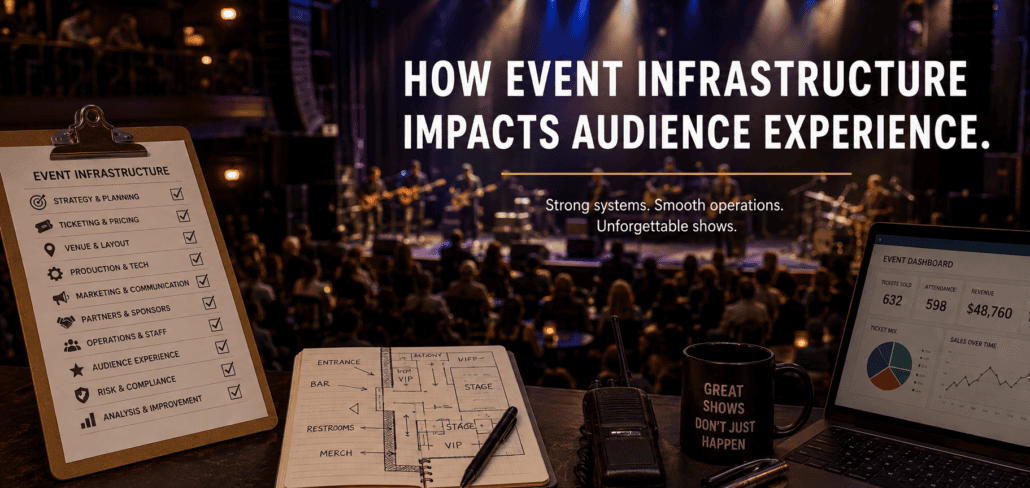
SYSTEMS: Event Infrastructure Impacts Audience Experience
A Systems Analysis of Live Music Production, Operational Fragmentation, and Experience Design
Abstract
Live music production operates as an interconnected service system in which artistic programming represents only one component of the audience experience. Ticketing, venue configuration, wayfinding, communication, production scheduling, pricing, hospitality, sponsorship, accessibility, security, stage management, marketing, artist operations, front-of-house procedures, and post-event analysis collectively determine whether an event functions as intended.
This case study examines recurring operational conditions observed across independently produced live music events in a historic multi-level concert venue. The analysis focuses on how established production systems respond when additional artists, promoters, partners, sponsors, community organizations, vendors, and other contributors enter an existing event structure.
The central finding is that operational complexity increases with each additional role and relationship. Increased participation produces value only when the production infrastructure absorbs the added complexity through defined authority, standardized communication, documented procedures, controlled information flow, and measurable responsibilities.
When new roles operate outside those systems, fragmentation develops. The effects eventually become audience-facing through inconsistent pricing, unclear messaging, difficult wayfinding, delayed performances, poor room utilization, confusing seating, inconsistent guest service, unfulfilled expectations, and reduced confidence in the event.
The analysis therefore treats audience experience as an operational output rather than an isolated marketing or hospitality function.
1. The Live Event as a Service System
A concert is a temporary operating environment.
Unlike a permanent business, the organization assembles much of its infrastructure for a limited period, operates under strict time constraints, serves hundreds of customers simultaneously, coordinates independent stakeholders, and dismantles the system immediately afterward.
The event therefore resembles a temporary service organization.
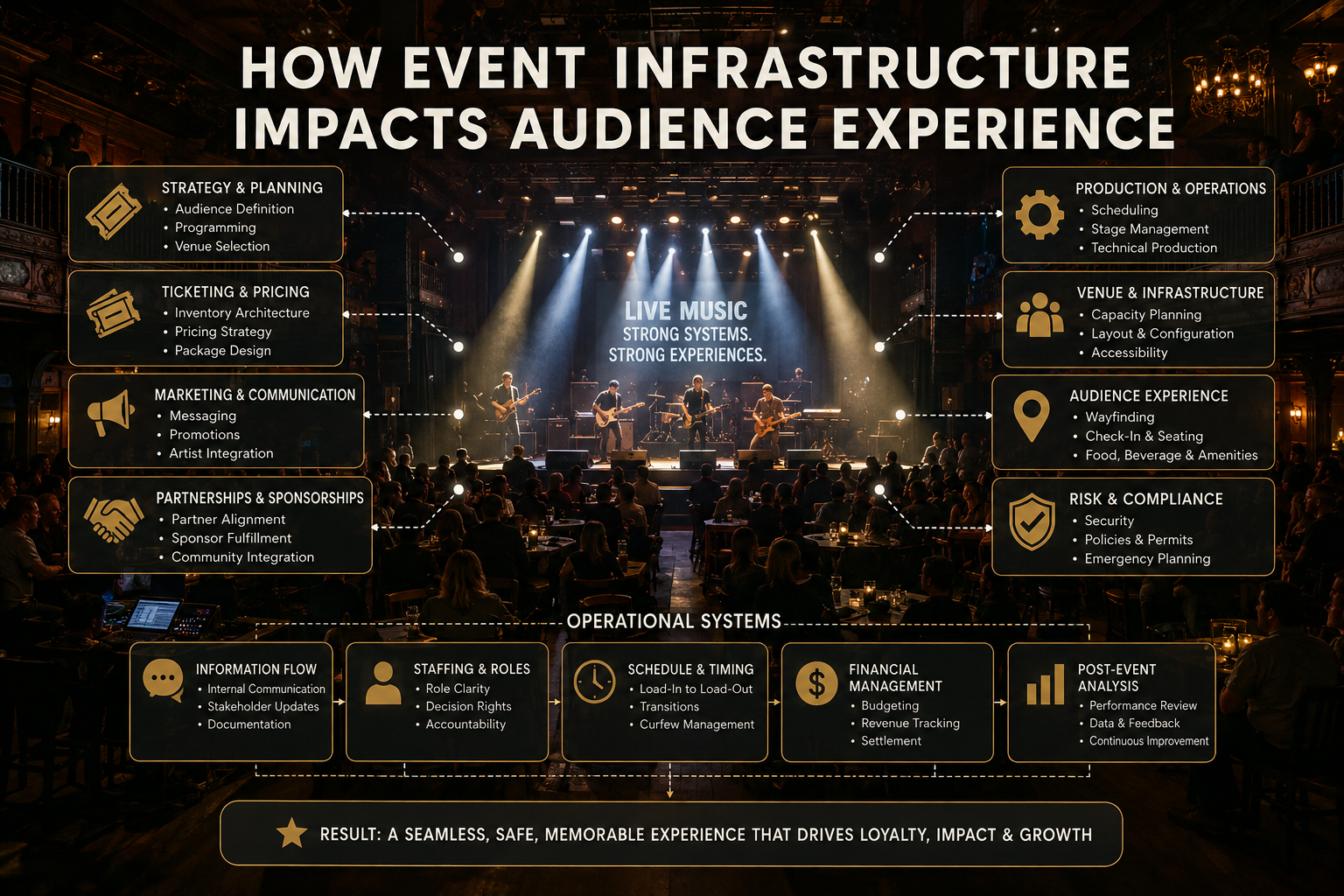
Its primary subsystems include:
Strategic systems
- Event purpose
- Audience definition
- Market positioning
- Financial model
- Programming strategy
- Venue selection
- Pricing architecture
- Risk allocation
Commercial systems
- Ticketing
- Sponsorship
- Partnerships
- Advertising
- Public relations
- Group sales
- Merchandise
- Vendor participation
Production systems
- Advancing
- Load-in
- Soundcheck
- Backline
- Stage management
- Artist transitions
- Technical production
- Run of show
- Curfew management
Guest systems
- Ticket discovery
- Purchase
- Confirmation
- Arrival
- Parking
- Entry
- Check-in
- Wayfinding
- Seating
- Accessibility
- Food and beverage
- Restrooms
- Guest support
- Exit
Information systems
- Internal communication
- Artist communication
- Venue communication
- Sponsor communication
- Partner communication
- Public messaging
- Signage
- MC scripts
- Emergency communication
- Documentation
Measurement systems
- Ticket sales
- Attendance
- Revenue
- Marketing conversion
- Complimentary admission
- Capacity utilization
- Schedule variance
- Partner performance
- Sponsor fulfillment
- Audience feedback
- Post-event reporting
These systems interact continuously.
A ticketing decision changes room configuration.
Room configuration changes staffing requirements.
Staffing affects ingress.
Ingress affects show-start reliability.
Show-start reliability affects audience satisfaction.
Sponsorship affects signage.
Signage affects visual hierarchy.
Visual hierarchy affects wayfinding.
Artist scheduling affects transitions.
Transitions affect total program length.
Program length affects venue labor and curfew compliance.
An isolated operational decision therefore rarely remains isolated.
2. Audience Experience as an Output Variable
Audience experience is often treated as an emotional or creative outcome.
Operationally, it is also a measurable system output.
The guest experiences the combined performance of multiple systems without seeing the infrastructure behind them.
A customer does not usually identify a failed information architecture.
The customer says:
“I didn’t know where to go.”
A customer does not identify inventory misallocation.
The customer says:
“The room looked empty.”
A customer does not identify a communication failure between production and front of house.
The customer says:
“Nobody knew where our seats were.”
A customer does not identify schedule variance.
The customer says:
“The show started late.”
A customer does not identify sponsor-activation failure.
The sponsor says:
“Our organization wasn’t mentioned.”
A customer does not identify an authority conflict.
The customer observes different staff members providing different answers.
Audience experience therefore functions as a downstream indicator of operational quality.
3. Demand Forecasting Versus Venue Capacity
One recurring error in independent event production is treating venue capacity as a sales forecast.
Capacity measures physical accommodation.
Demand measures probable purchasing behavior.
The two variables are unrelated unless market evidence connects them.
A venue might accommodate:
- 150 guests downstairs
- 100 guests upstairs
- A larger number under a standing configuration
None of those numbers establishes expected attendance.
Demand forecasting should instead consider:
- Historical ticket sales
- Artist draw
- Geographic concentration of followers
- Prior venue performance
- Email-list size
- Social engagement
- Paid advertising conversion
- Competing events
- Ticket price
- Purchase lead time
- Day of week
- Event frequency
- Artist exclusivity
- Market saturation
- Weather exposure
- Audience demographics
- Group-sales opportunities
- Partner reach
An artist with several thousand social followers does not necessarily produce several hundred ticket buyers.
Follower count measures potential digital reach.
Ticket sales measure behavioral conversion.
Historical paid attendance provides stronger forecasting evidence.
4. Ticket Inventory as Capacity Engineering
A venue’s maximum occupancy should not automatically become its available ticket inventory.
Ticket inventory should reflect the intended event configuration.
A producer might intentionally release fewer tickets than the room physically accommodates.
Reasons include:
- Maintaining comfortable density
- Protecting sightlines
- Creating table spacing
- Preserving circulation routes
- Maintaining accessible pathways
- Supporting food and beverage service
- Improving ingress and egress
- Creating premium seating zones
- Avoiding an underfilled appearance
- Matching realistic demand
- Supporting staged inventory releases
This creates a distinction between:
Physical capacity: Maximum occupancy permitted within a configuration.
Operational capacity: Number of guests the production system comfortably supports.
Commercial inventory: Number of tickets intentionally offered for sale.
Those numbers should not automatically be equal.
5. Inventory Architecture and Buyer Behavior
Ticket architecture influences customer decisions.
Consider an event offering only four-person tables.
A customer interested in attending with one companion encounters an unnecessary purchasing barrier.
The problem might not be ticket price.
The problem might be package size.
Introducing a limited number of two-person tables addresses the barrier without reducing the underlying value of admission.
This illustrates an important principle:
Price resistance and configuration resistance are different problems.
Lowering price in response to configuration resistance sacrifices revenue without addressing the actual obstacle.
A stronger ticketing system evaluates:
- Individual GA
- Couples
- Four-person groups
- Larger social groups
- Premium buyers
- Sponsors
- Community partners
- Accessible seating needs
Inventory should match probable purchasing units.
6. Staged Inventory Release
Releasing every possible ticket simultaneously provides maximum choice but might weaken several commercial signals.
A staged release allows production to manage:
- Scarcity
- Room density
- Premium inventory
- Buyer behavior
- Revenue forecasting
- Marketing language
- Demand testing
For example, an event might initially prioritize reserved tables, then introduce smaller reserved packages, followed by GA inventory.
The process provides behavioral data.
If two-person tables sell quickly while four-person tables remain available, the market has identified a configuration preference.
If GA sells while premium inventory stalls, price or experience differentiation requires examination.
If no category sells, adding more inventory will not solve the underlying demand problem.
Inventory release therefore functions as both a revenue mechanism and a diagnostic instrument.
7. Pricing Architecture
Ticket price communicates positioning.
An event with:
- Reserved seating
- Historic architecture
- Table service
- Controlled capacity
- Premium sightlines
- Short transitions
- Curated programming
offers a different product from an outdoor multi-act festival featuring some of the same performers.
Artist overlap does not make the products identical.
Pricing should therefore consider total experience value.
Relevant variables include:
- Venue
- Comfort
- Seating
- Artist access
- Program duration
- Exclusivity
- Production quality
- Convenience
- Hospitality
- Service level
- Competitive events
Repeated discounting introduces another variable: customer learning.
If customers learn that prices fall shortly before every event, waiting becomes economically rational.
Discounting therefore affects future purchasing behavior, not only current revenue.
8. Revenue Engineering and Break-Even Control
Event budgeting should distinguish between maximum potential revenue and realistic expected revenue.
A simple maximum calculation might multiply:
Venue capacity × ticket price
That produces theoretical gross revenue.
It does not produce a reliable operating forecast.
A stronger model uses:
- Conservative attendance
- Expected attendance
- High-demand attendance
- Weighted ticket mix
- Complimentary inventory
- Processing fees
- Taxes
- Advertising
- Talent expense
- Venue expense
- Production labor
- Hospitality
- Insurance
- Security
- Contingency
Revenue scenarios should exist before expenses expand.
The production team should also recalculate remaining potential revenue as expenses change.
If expenses decline, inventory strategy might change.
If expenses rise, break-even attendance changes.
Financial planning should remain connected to ticket operations throughout the sales cycle.
9. Complimentary Admission as Inventory
Complimentary tickets have economic value.
A complimentary seat represents:
- Lost potential revenue
- Occupied capacity
- A benefit assigned to someone
- A precedent for future requests
Complimentary admission should therefore have categories.
Examples include:
Operational comps
- Working personnel
- Required artist guests
- Media
- Production needs
Promotional comps
- Giveaways
- Radio promotions
- Partner campaigns
Relationship comps
- Strategic guests
- Donors
- Industry professionals
Sponsor inventory
- Tickets included within paid sponsorship packages
The distinction matters.
Fifteen tickets given to a community organization represent a different transaction from two GA tickets supplied for a promotional raffle.
The first resembles sponsorship inventory.
The second resembles promotional acquisition.
Without a comp policy, event inventory becomes vulnerable to informal requests.
10. Partnership Architecture
Community organizations often provide significant value to independent events.
Examples include:
- Professional associations
- Social clubs
- Environmental organizations
- Business groups
- Media organizations
- Community organizations
- Universities
- Nonprofits
Their value might include:
- Audience access
- Email distribution
- Social promotion
- Credibility
- Community alignment
- Group attendance
- Content distribution
A structured partnership system should define the exchange.
A promotional partnership might receive:
- Designated logo placement
- Vendor presence
- Stage acknowledgment
- Spotlight content
- Media inclusion
- Limited giveaway inventory
The partner provides defined promotional actions.
The system should specify:
- Number of posts
- Required ticket link
- Newsletter placement
- Posting dates
- Approval requirements
- Logo specifications
- On-site responsibilities
“Help promote the show” is not an operational specification.
11. Sponsorship Architecture
Sponsorship represents a different commercial relationship.
The sponsor contributes financial or material resources in exchange for defined assets.
Those assets might include:
- Reserved tickets
- Premium seating
- Stage presentation time
- Vendor space
- Brand placement
- Promotional features
- Media mentions
- Hospitality access
- Product integration
The distinction between partnership and sponsorship protects commercial value.
If promotional partners receive the same benefits as paying sponsors, sponsorship loses economic differentiation.
Benefits therefore require an assigned value.
12. Brand Architecture
Event marketing should establish visual hierarchy before external organizations enter the campaign.
The hierarchy might include:
- Event name
- Artist
- Date
- Venue
- Ticket call to action
- Producer
- Sponsor
- Partner
- Community contributor
Not every item belongs on every asset.
Primary sales advertising often performs better when it communicates the purchase decision quickly.
Recognition materials serve a different purpose.
A production system might therefore separate:
Sales materials
- Paid advertising
- Ticket graphics
- Artist announcements
- Conversion campaigns
Recognition materials
- Marquee posters
- Sponsor boards
- Venue signage
- Programs
- Stage slides
- Partner graphics
The separation reduces visual competition and prevents every stakeholder from treating primary advertising as organizational recognition space.
13. Information Architecture
Live-event communication requires information classification.
Not everyone needs every piece of information.
The system should distinguish between:
Strategic information
Pricing, financial assumptions, partnerships, sponsorship, contracts.
Production information
Load-in, soundcheck, backline, set lengths, transitions, stage plots.
Guest information
Doors, parking, accessibility, seating, ticket requirements.
Partner information
Deliverables, promotional assets, deadlines, recognition.
Venue information
Capacity, staffing, security, curfew, alcohol policy, technical requirements.
When every participant enters every communication thread, information volume increases while clarity often decreases.
A better structure routes information according to responsibility.
14. Decision Rights
Role titles alone do not establish authority.
A production system should identify decision rights.
For each operational area, the team should know:
- Who owns the decision?
- Who provides input?
- Who approves?
- Who executes?
- Who receives notification?
Areas requiring explicit ownership include:
- Ticket price
- Inventory
- Artist lineup
- Set times
- Marketing
- Sponsor agreements
- Complimentary admission
- Partner relationships
- Venue communication
- Stage announcements
- Room configuration
- Guest policies
Without defined decision rights, collaborators might reasonably assume authority based on proximity to the issue.
That creates duplicate decision-making.
15. Communication Topology
Communication structure affects operational reliability.
A fragmented model might look like:
Artist → Promoter → Partner → Producer → Venue
while another conversation follows:
Partner → Sponsor → Artist → Producer
Important information changes as it moves through each person.
A centralized model reduces transmission error.
For example:
External stakeholder → designated event contact → responsible department or producer
The goal is not control for its own sake.
The goal is information integrity.
16. Audience Wayfinding
Wayfinding is one of the clearest examples of infrastructure becoming experience.
A multi-level venue introduces several navigation questions:
- Where is check-in?
- Which entrance should guests use?
- Where is GA?
- Where are reserved tables?
- Which staircase reaches the balcony?
- Which balcony section belongs to a partner?
- Where are restrooms?
- Where is merchandise?
- Where is the bar?
- Where is accessible seating?
- Where should sponsors report?
- Where should artists enter?
- Where should media check in?
Poor wayfinding increases cognitive load on both guests and staff.
Every unanswered environmental question becomes a staff interaction.
That creates queues and inconsistent answers.
Wayfinding should therefore combine:
- Pre-event instructions
- Entry signage
- Check-in labels
- Directional signs
- Section identifiers
- Table numbers
- Wristband systems
- Staff positioning
- Accessible routes
The environment itself should answer common questions before a guest needs assistance.
17. Check-In Architecture
Check-in should separate guest categories when appropriate.
Possible categories include:
- GA
- Reserved seating
- VIP
- Sponsors
- Partners
- Media
- Guest list
- Artists
- Staff
The system should establish:
- Ticket scanner
- Guest list
- Wristband colors
- Table assignments
- Escalation contact
- Re-entry policy
- Walk-up sales procedure
A staff member should not need to contact the producer every time an unfamiliar name appears.
Exceptions should have predetermined escalation rules.
18. Room Zoning
Venue layout should support both audience experience and operational control.
Zones might include:
- GA floor
- Reserved floor
- Premium tables
- Balcony
- Sponsor area
- Partner area
- Merchandise
- Artist-only space
- Green room
- Production position
Each zone requires:
- Capacity
- Access rules
- Signage
- Staffing
- Ticket designation
Uncontrolled movement between zones weakens the value of premium tickets.
A customer who paid for reserved access should experience a meaningful difference from GA.
19. Accessibility as Infrastructure
Accessibility should enter planning before tickets go on sale.
Relevant considerations include:
- Step-free entry
- Accessible seating
- Companion seating
- Restroom access
- Circulation width
- Sightlines
- Seating height
- Check-in assistance
- Emergency egress
Accessibility decisions affect room configuration and inventory.
Treating accessibility as a day-of accommodation creates unnecessary operational risk.
20. Audience Ingress
Ingress is a capacity problem measured over time.
If 120 guests arrive within 20 minutes, the event must process approximately six guests per minute to avoid increasing the queue.
Processing time depends on:
- Ticket scanning
- ID checks
- Wristbands
- Bag policies
- Guest-list verification
- Table assignments
- Security
- Walk-up sales
Marketing affects ingress because advertising influences arrival behavior.
If every message tells guests the artist begins at 8:00 PM, arrivals might cluster near 7:50 PM.
Doors and pre-show communication should therefore support arrival distribution.
21. Stage Management
Stage management converts the written schedule into actual performance timing.
A run of show might allocate:
- 20-minute opening set
- 5-minute transition
- 40-minute second set
- 10-minute transition
- 45-minute headline set
That schedule works mathematically only if the production system supports it.
Five-minute transitions require:
- Advance preparation
- Shared backline where appropriate
- Pre-positioned equipment
- Defined stage plots
- Available musicians
- Clear changeover assignments
- Immediate line checks
A five-minute transition written into a spreadsheet does not create a five-minute transition operationally.
The infrastructure must make the target achievable.
22. Transition Engineering
Transitions are often treated as empty time.
They are operational events.
A transition might require:
- Removing instruments
- Moving amplifiers
- Changing microphones
- Adjusting monitors
- Moving drum hardware
- Repatching inputs
- Line checking
- Introducing the next artist
Transition design should identify which tasks occur:
Sequentially
and which occur:
Simultaneously
Parallel activity reduces transition time.
For example, the MC might address the audience while stage personnel change equipment.
The audience experiences continuous programming while production completes technical work.
23. MC Systems
The MC functions as part of the information infrastructure.
Responsibilities might include:
- Welcome
- Safety information
- Sponsor acknowledgment
- Artist introduction
- Transition management
- Calls to action
- Closing
Speaker cards reduce variance.
Cards should identify:
- Exact names
- Pronunciations
- Sponsor language
- Timing
- Prohibited claims
- Ticket information
- Closing language
An MC should not independently redefine organizational roles from the stage.
Public statements become part of the event record.
24. Producer-Performer Role Conflict
An organizer who also performs creates a temporary control gap.
During the performance, that person cannot simultaneously:
- Handle guest escalations
- Coordinate venue issues
- Resolve ticket problems
- Manage sponsor requests
- Adjust schedules
- Communicate with artists
- Supervise front of house
The event therefore needs delegated authority.
A designated stage manager or event lead should receive temporary operational control.
The delegation should occur before doors open.
25. Artist Advancing
The advance converts contracts and expectations into executable production information.
It should confirm:
- Arrival
- Parking
- Load-in
- Soundcheck
- Set time
- Set duration
- Backline
- Inputs
- Stage plot
- Hospitality
- Green room
- Merchandise
- Guest list
- Curfew
- Settlement
Failure to follow the advance creates downstream variance.
Late arrival affects soundcheck.
Late soundcheck affects doors.
Delayed doors affect ingress.
Delayed ingress affects show start.
The audience eventually experiences an artist-advance failure as a late concert.
26. Venue Interface
The venue is another operating system.
The producer’s model must integrate with:
- Venue management
- Sound personnel
- Security
- Bar staff
- Door staff
- Capacity restrictions
- Curfew
- House policies
- Technical limitations
Venue communication should therefore have one designated production interface whenever possible.
Conflicting instructions from multiple promoters or artists increase operational risk.
27. Local Partners as Distribution Infrastructure
Local organizations provide more than promotional visibility.
They function as distribution networks.
A professional association, social club, nonprofit, environmental organization, university group, or community organization might provide access to a concentrated audience unavailable through paid advertising.
The value of the partnership depends on:
- Audience alignment
- Membership size
- Communication frequency
- Email access
- Social engagement
- Geographic concentration
- Conversion history
Partnership selection should therefore use audience-fit criteria rather than logo recognition alone.
28. Local Partners as Experience Infrastructure
Partners might also improve the physical event.
Examples include:
- Hosted balcony mixers
- Member check-in
- Educational activations
- Community information
- Networking
- Hospitality
- Audience introductions
These activations require integration into:
- Floor plans
- Ticketing
- signage
- staffing
- stage scripts
- sponsor hierarchy
A partnership becomes operational once it changes how people use the venue.
29. Hospitality Systems
Hospitality affects artist performance and operational reliability.
A hospitality plan might address:
- Green room access
- Meals
- Water
- Dietary requirements
- Alcohol policy
- Guest restrictions
- Timing
- Cleanup
Hospitality should support production rather than interfere with it.
An artist who remains backstage after the scheduled departure time, introduces unauthorized guests, or becomes impaired creates operational risk.
Policies should therefore exist before the event.
30. Sustainability Systems
Sustainability also affects event infrastructure.
Operational considerations include:
- Reusable serviceware
- Waste sorting
- Single-use plastic reduction
- Digital ticketing
- Local vendors
- Plant-based hospitality
- Transportation information
Sustainability works best when integrated into procurement and operations rather than added as an event-day message.
31. Security and Risk Control
Security planning should consider:
- Capacity
- Alcohol
- Artist profile
- Audience profile
- Entry
- Re-entry
- Backstage access
- Cash handling
- Equipment
- Emergency exits
- Medical incidents
Risk controls should identify escalation authority.
Staff need to know who makes the final decision when normal procedures fail.
32. Curfew as a Hard Constraint
Curfew should be treated as a system constraint rather than a target.
If the venue requires completion by 10:00 PM, the schedule should not mathematically end at 10:00 PM unless production confidence supports zero variance.
Buffers reduce risk.
A five-minute delay early in the evening should not automatically produce a five-minute curfew violation.
Schedule engineering should account for uncertainty.
33. Marketing Operations
Marketing should follow an event lifecycle.
Possible stages include:
Awareness
Introduce event concept and artists.
Education
Explain why the lineup matters.
Experience
Show venue, seating, atmosphere, and value.
Conversion
Promote ticket categories and urgency.
Scarcity
Communicate legitimate inventory reduction.
Final call
Address last-minute buyers.
Marketing should reflect actual operational conditions.
Artificial scarcity or inaccurate sellout claims damage trust.
34. Artist Marketing Integration
Artists should receive a promotional package containing:
- Approved artwork
- Ticket link
- Suggested copy
- Posting dates
- Tags
- Venue information
- Event description
Without centralized assets, each artist might communicate a different version of the event.
Consistency reduces customer confusion.
35. Public Relations
PR provides another audience-acquisition channel.
A release should communicate:
- News value
- Headliner
- Supporting artists
- Venue
- Date
- Genre
- Ticket information
- Distinctive event context
Artist hierarchy should remain accurate.
Highlighting a headliner should not erase supporting artists.
Programming hierarchy and marketing hierarchy should align.
36. Experience Differentiation
Independent events frequently compete against other events featuring overlapping artists.
The producer therefore needs an experience proposition beyond artist access.
Differentiators might include:
- Historic venue
- Reserved seating
- Premium tables
- Indoor climate control
- Short program
- Early ending
- Networking
- Community partnerships
- Artist storytelling
- High production standards
The audience should understand why this event merits its particular price.
37. Operational Fragmentation
Fragmentation occurs when previously integrated functions separate without replacement coordination.
Examples include:
- One person controls marketing while another changes ticket strategy.
- A partner negotiates guest benefits without access to inventory economics.
- An artist communicates directly with the venue while production maintains a separate plan.
- An MC changes public messaging.
- A sponsor receives benefits outside the established sponsorship structure.
- Multiple people issue instructions to front-of-house staff.
Each action might appear reasonable independently.
Collectively, they create system variance.
38. The Cost of Added Roles
Every additional stakeholder increases the number of potential communication relationships.
The important issue is therefore not headcount alone.
It is interface count.
In Beyond Music, Chapter 2, “Leadership Team, Not Management,” addresses how adding roles, responsibilities, and decision-makers without clearly defined authority, communication pathways, and accountability increases organizational complexity, role conflict, duplication, and bottlenecks. On the surface, adding more roles might appear community-driven, collaborative, and inclusive. Operationally, each addition introduces new communication interfaces, decision points, dependencies, and opportunities for conflicting authority. When roles are inserted into an established operating structure without a defined organizational need or formal integration into existing systems, participation increases faster than operational capacity, creating fragmentation rather than additional support.
A producer should ask:
- What information does this role need?
- What authority does this role hold?
- Who communicates with this role?
- What outputs does this role produce?
- What systems does this role affect?
- What happens if this role fails?
Adding people without answering those questions increases complexity without necessarily increasing operational capacity.
39. Standardization Versus Flexibility
Systemization does not require rigid events.
A strong system defines what remains fixed and what remains adjustable.
Fixed elements might include:
- Safety
- Financial controls
- Ticketing authority
- Brand standards
- Sponsor hierarchy
- Advance deadlines
- Curfew
- Check-in procedures
Flexible elements might include:
- Artist order
- Marketing copy
- Partner activations
- Seating inventory
- Promotional timing
Standardization protects critical infrastructure.
Flexibility allows the event to respond to demand.
40. Post-Event Measurement
A concert should generate operational data.
The post-event review should compare plan against outcome.
Useful measures include:
Commercial
- Gross ticket revenue
- Net ticket revenue
- Average ticket value
- Paid attendance
- Complimentary attendance
- Ticket mix
- Refunds
Marketing
- Impressions
- Clicks
- Ticket-page visits
- Conversion
- Cost per purchase
- Email performance
- Partner referrals
Operations
- Load-in variance
- Soundcheck variance
- Door variance
- Set-time variance
- Transition duration
- Curfew compliance
Audience
- Arrival distribution
- Seating issues
- Accessibility requests
- Complaints
- Survey results
- Repeat purchase
Partnership
- Posts completed
- Referral sales
- Attendance
- Sponsor deliverables
- Activation performance
The data should influence the next event.
41. System Feedback
A mature event model operates as a feedback system.
Observed buyer behavior modifies ticket architecture.
Observed arrival patterns modify door procedures.
Observed transition times modify future schedules.
Partner conversion modifies partnership selection.
Audience complaints modify wayfinding.
Artist reliability modifies future booking decisions.
The event therefore improves through documented feedback rather than organizational memory alone.
42. Technical Finding
The evidence supports a broader operational principle:
Audience experience quality depends on the reliability of the interfaces connecting event subsystems.
The individual quality of each component is insufficient.
A strong artist plus weak ticketing creates friction.
Strong marketing plus weak ingress creates queues.
Strong sponsorship plus weak fulfillment creates dissatisfaction.
Strong production plus unclear wayfinding creates guest confusion.
Strong programming plus uncontrolled transitions creates schedule failure.
System performance depends on coordination between components.
43. Recommended Live Event Infrastructure
A repeatable independent concert model should contain, at minimum:
- Event brief
- Financial model
- Demand forecast
- Ticket architecture
- Venue configuration
- Responsibility matrix
- Communication map
- Artist advance
- Marketing calendar
- Partnership framework
- Sponsorship framework
- Comp policy
- Floor plan
- Wayfinding plan
- Accessibility plan
- Ingress procedure
- Check-in system
- Run of show
- Stage plots
- Transition plan
- MC cards
- Hospitality plan
- Security plan
- Emergency escalation structure
- Settlement procedure
- Post-event report
The system should exist before additional participants enter the production.
New roles then attach to the system rather than redesigning it informally.
Conclusion
Live music audiences evaluate an event through hundreds of small interactions.
They discover an advertisement.
They interpret the ticket offer.
They decide whether the price matches the expected experience.
They receive confirmation.
They travel to the venue.
They find parking.
They locate the entrance.
They check in.
They identify their seating area.
They find the restroom.
They purchase a beverage.
They interpret signage.
They listen to announcements.
They wait through transitions.
They watch the artists.
They leave the venue.
Each interaction depends on infrastructure.
The artistic performance remains central to a concert, but the production system determines the conditions under which the audience encounters the performance.
Operational fragmentation changes those conditions.
Adding a promoter, partner, sponsor, MC, vendor, artist representative, community organization, or other stakeholder increases the number of interfaces the event must manage. The addition improves the event only when the operating model defines the role, communication pathway, authority, deliverables, and relationship to existing systems.
The strongest event infrastructure therefore does not seek maximum participation.
It seeks controlled integration.
A well-designed live event system aligns commercial strategy, production operations, audience movement, communication, financial controls, partnerships, artist needs, venue requirements, and experience design around one coordinated operating model.
When those systems align, the audience rarely notices the infrastructure.
They notice that purchasing was clear, arrival was easy, seating made sense, the program started on time, transitions moved efficiently, partners fit naturally into the experience, the venue felt organized, and the event delivered what the ticket promised.
Those outcomes are not incidental.
They are the measurable result of event infrastructure.

Leave a Reply
Want to join the discussion?Feel free to contribute!